
Bible Passage:
The Anchor in the Storm is more than a poetic phrase — it’s a powerful truth for anyone facing life’s fiercest challenges. Just as a ship’s anchor holds firm against violent waves, our hope in God holds us steady through trials.
Hebrews 6:19 (NIV):
“We have this hope as an anchor for the soul, firm and secure. It enters the inner sanctuary behind the curtain…”
Illustration:
The Achor in the Storm. On a cold and rainy evening, in a coastal village where sea storms were as common as sunsets, lived a retired sailor named Eli. Weathered by years of navigating the deep waters, Eli knew the ocean like he knew the lines on his palm. His small cottage, nestled atop a cliff, overlooked the relentless waves below. In that cottage, memories of storms, rescue missions, and lost friends lived on the walls—photographs, maps, anchors, and oil lanterns hung in solemn silence.
Eli had a grandson, Noah, a teenager who had never known the open seas, only heard stories. Unlike his grandfather, Noah grew up in an age where the internet sailed faster than any ship, and storms were metaphorical more than real—until one season, when life took an unexpected turn.
Noah’s father, a local fisherman and Eli’s son, drowned in an unexpected monsoon swell. The family’s world shifted like tectonic plates beneath their feet. His mother retreated into a shell of silence, and Noah—angry, broken, confused—turned inward. The vibrant, cheerful teen became reclusive, snapping at everyone, questioning everything, especially God.
One morning, as the rain gently tapped on the roof, Eli invited Noah to the boathouse.
“Come, I want to show you something,” Eli said, motioning with his hand.
Noah followed reluctantly. Inside, amidst coiled ropes and rusted tools, hung a large iron anchor. It had been on Eli’s first ship, the one that had nearly sunk during a typhoon. He reached out and touched it, reverently.
“This,” Eli said, “was my Anchor in the Storm. It held me steady in the worst night of my life. We lost sails, we lost direction, but this anchor… it didn’t let us drift. It dug deep into the unseen floor and reminded us we were still held.”
Noah looked at the anchor, confused. “But how is that supposed to help me now, Grandpa?”
Eli sat on a wooden bench and gestured for Noah to join him. “Because hope works like an Anchor in the Storm, son. You don’t see it working, but it’s there—beneath the surface, gripping something stronger than you.”
Noah stared at the iron hulk.
“But hope isn’t easy,” he murmured.
Eli nodded. “No. It’s not easy. And it doesn’t erase pain. But it steadies you.”
The old man opened his Bible and pointed to a verse highlighted in yellow—Hebrews 6:19. “We have this hope as an anchor for the soul. Firm and secure. That’s God’s promise. He is your true Anchor in the Storm.”
Noah didn’t respond then. But he kept returning to that boathouse. Kept looking at that anchor. Weeks turned to months. Grief didn’t vanish, but something in him shifted—like a boat facing the same wind, but now with something firm beneath.
He eventually returned to school. He joined a youth group. And when asked what helped him stay afloat during that stormy season, Noah simply said:
“My Anchor in the Storm held.”
Lessons from The Anchor in the Storm
The sea that morning was calm, almost deceptively so. But every seasoned sailor in the harbor could smell it—the storm that was brewing beyond the horizon. Fishermen mended their nets quickly, clouds gathered like a dark army, and the wind carried a warning. Among the boats preparing to face the day was a small vessel captained by Jonah, a man who had weathered many tempests yet never forgot the importance of The Anchor in the Storm.
Jonah had learned about The Anchor in the Storm early in his life. As a young deckhand, he once found himself in the middle of a hurricane that tore through the bay, smashing ships against jagged rocks. In that chaos, it was The Anchor in the Storm that held his boat fast, buried deep in the unseen seabed. That moment became his defining lesson: storms come without warning, but an anchor—if strong and sure—can save your life.
Years later, Jonah passed this lesson to his crew, reminding them that life itself is an ocean. There are days when the water is glass, and you think you can sail forever without fear. But there are also days when the sky turns black, the waves tower over you, and every direction looks like disaster. In those moments, The Anchor in the Storm becomes more than a tool—it becomes hope itself.
The way Jonah explained it, The Anchor in the Storm is not meant to prevent the storm from coming. It doesn’t silence the thunder or calm the waves instantly. Instead, it keeps you from drifting into destruction. It’s your unseen connection to safety, your lifeline to something immovable. Just as a real anchor grips the ocean floor, The Anchor in the Storm for the soul grips eternal truths that don’t change, no matter how violent the tempest.
He often quoted Hebrews 6:19 to his young sailors: “We have this hope as an anchor for the soul, firm and secure.” Jonah would say, “This is more than poetry—it’s the blueprint for survival. The Anchor in the Storm is Jesus Himself.”
One evening, after a long day of fishing, the crew found themselves surrounded by rolling fog. The compass spun uselessly, and the wind shifted erratically. Then the waves began to rise. Jonah’s younger crew members panicked, but Jonah calmly walked to the bow, checked their position, and ordered the anchor dropped. “Trust The Anchor in the Storm,” he said. “It’s been holding sailors steady for thousands of years.”
They waited through the night. Rain pounded the deck, and the ship groaned under the strain. But the anchor never moved. At sunrise, the storm broke apart, revealing a clear horizon. The crew looked at Jonah in awe, realizing he had trusted something deeper than his own strength.
Jonah smiled. “Life will test you. Your faith will be shaken. But when you are connected to The Anchor in the Storm, you will not drift away. The waves may crash, but your soul will remain steady.”
From that day on, his crew never set sail without checking the anchor first—not just the metal one for the ship, but also the one for their hearts. They carried the lesson forward, telling others about The Anchor in the Storm, the steadfast hope that holds even when the world feels like it’s falling apart.
And Jonah knew the truth: storms will always come, but they will never have the final word—not when you are held by The Anchor in the Storm.
When the Anchor Speaks: Finding Peace in the Storm with Jesus
The night had swallowed the horizon, and the sea had turned into a wild, roaring beast. A small fishing vessel was caught in the heart of the tempest, tossed up and slammed down by waves as tall as houses. The rain pelted like shards of glass, and the wind screamed in unrelenting fury. Every instinct in the sailor’s heart told him to panic—but he did not.
Why? Because he knew he had the anchor in the storm.
Beneath the angry surface, hidden from sight, a strong, unyielding anchor gripped the seabed with absolute determination. Though the boat was tossed, it was not lost. Though the storm roared, the anchor held. The sailor could not see it, but he knew it was there. It was the quiet, steadfast assurance that no matter how wild the night became, something stronger was holding him.
In life, we all face our own raging seas—moments when the darkness closes in, when fear claws at our hearts, and when our own strength feels too small. In those times, the anchor in the storm is God’s presence. We may not always see Him. We may not always feel Him in the chaos. But He is there—silent sometimes, yet unshakably strong—holding us when everything else feels like it’s slipping away.
God’s presence is not like a fragile rope that might snap under pressure; it is like the anchor in the storm—firm, unmovable, and deeply rooted. His grip on us is not determined by the size of the waves but by the depth of His love. Even when our prayers feel unanswered and our hope feels thin, His presence is still wrapped around us, keeping us from drifting into despair.
Imagine the sailor in the middle of the night. The storm doesn’t stop immediately. The wind doesn’t calm all at once. But because of the anchor in the storm, the boat does not break apart. In the same way, God’s presence does not always remove the storm, but it keeps us from being destroyed by it. His nearness may not always come with loud signs or miraculous instant calm, but it comes with an unshakable security—“I am with you; I will never leave you nor forsake you.”
When morning comes, the storm may still be there, but the sailor’s confidence remains. The anchor is still in place. And when at last the skies clear and the sun returns, the sailor knows that the reason he survived was not because of his own power but because of the anchor in the storm.
And so it is with us. God’s presence is our anchor in the storm. When fears threaten to pull us under, when doubts pound at our minds, when loneliness whispers that we are forgotten, His presence whispers louder, “You are held. You are safe. I will not let you go.”
No matter the size of the waves or the length of the night, if we are held by the anchor in the storm, we will not be lost.
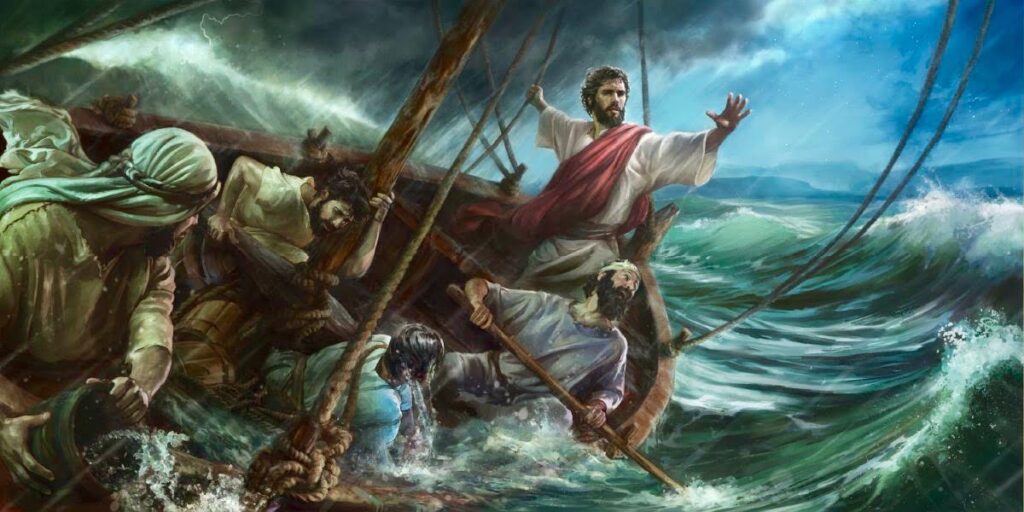
The night on the Sea of Galilee was supposed to be a simple crossing. Jesus had just finished teaching, and He told His disciples, “Let us go over to the other side.” They stepped into the boat, the water gentle, the air cool. But as often happens on the Galilee, the weather changed without warning.
Dark clouds rolled over the hills. The wind rose sharply. Then, without mercy, a violent storm erupted. Waves slammed into the boat, spilling icy water over the sides. The disciples, some of them experienced fishermen, had faced storms before—but this one was different. This one felt deadly. The boat pitched and groaned, the spray stung their faces, and their voices rose in fear.
In the chaos, they turned and saw something shocking: Jesus was asleep. The storm raged, the boat swayed violently, and yet He lay on a cushion, utterly at peace. Desperate, they shook Him awake: “Teacher, don’t you care if we drown?”
What happened next is the essence of the anchor in the storm.
Jesus rose, stood in the rocking boat, and with calm authority spoke to the wind and waves: “Quiet! Be still!” And instantly, the sea fell silent. The wind died down. The water turned to glass. The disciples, still trembling, could hardly breathe—not from fear of the storm anymore, but from awe at the One who commanded it.
In that moment, they realized the anchor in the storm wasn’t a rope, a weight, or even their skill as sailors—it was the presence of Jesus Himself. The storm had no power over them because the One who made the wind and waves was in their boat.
Our lives mirror that night far more often than we wish. The storms come without warning—illness, loss, fear, betrayal—and the waves rise higher than we think we can endure. We cry out, “Lord, don’t you care?” And sometimes it seems like He’s asleep. But even in the moments when God seems silent, He is still the anchor in the storm. His presence is our security, whether He calms the waters instantly or holds us steady until the skies clear.
The disciples thought they needed the storm to stop in order to survive. What they really needed was to remember who was with them. The same is true for us. God’s presence does not always remove the storm, but it changes everything about how we go through it. He is unshakable, immovable, and deeply anchored in His promises.
When your heart feels battered by waves of fear…
When your strength feels small against the wind…
When the night is long and the clouds show no sign of parting…
Remember this: The One who calms seas is in your boat. He is your anchor in the storm, your unmovable hope, and your unshakable peace.
The disciples’ boat didn’t survive that night because the weather improved—it survived because the anchor in the storm was with them. And the same is true for you.
Reflection – Anchored in Hope: The Anchor in the Storm
When life feels like a relentless storm—loss, worry, betrayal, or fear raging around your heart—the concept of the Anchor in the Storm becomes more than poetic imagery. It becomes a lifeline. In Hebrews 6:19, hope is described as “an anchor for the soul, firm and secure,” one that “enters the inner sanctuary behind the curtain.”
Unlike a fleeting wish, Christian hope is rooted in something deeper—it isn’t built on shaky circumstances but on God’s unchanging nature. As GotQuestions.org explains, this hope “holds us steady in this life and secure in the future because it is firmly attached to the eternal throne of God.”
5 Reasons the Anchor in the Storm Brings Peace:
1. Why Hope Is Described as an Anchor
The imagery of an anchor speaks of stability and immovability in uncertain waters. BibleHub’s commentary notes that just as a ship’s anchor grips the unseen seabed, Christian hope grips eternal truth—truth not rooted in feelings but in the character of God.
When storms come—loss, betrayal, disappointment, fear—this anchor prevents us from drifting into despair. Hope doesn’t deny the storm; it acknowledges it and still chooses to believe in God’s promises, promises that Desiring God reminds us have been proven over generations.
2. What Happens When We Lose Our Anchor
Many today are spiritually adrift. When hope is anchored to unstable things—money, status, human approval, or self-effort—the waves of life push us wherever they please. As the blog Hope and Light puts it, “Without an anchor to keep us steady … our souls … will be tossed to and fro.”
Without this anchor, life becomes reactionary. We live from crisis to crisis. Anxiety rises. Cynicism takes root. But with Christ as our Anchor, we have something stable to return to—even when emotions fluctuate.
3. Jesus—The Anchor Beyond the Veil
The second half of Hebrews 6:19 references the “inner sanctuary behind the curtain,” a direct connection to the Holy of Holies in the Old Testament temple. This is where God’s presence dwelled. Hebrews tells us that Jesus, as our High Priest, entered there on our behalf.
This means our hope isn’t anchored in religious performance, but in the finished work of Christ. As GotQuestions.org explains, “Our hope is in what Jesus has already accomplished.” He has conquered sin and death, secured our access to God, and fastened our soul to heaven’s throne.
4. Holding On When You Can’t See the Bottom
Anchors do their work beneath the surface. You can’t always see them, but they hold nonetheless. In the same way, hope works in unseen ways. You may pray and hear silence, obey yet still face struggle. Still, hope whispers, “Hold on. Something deeper is happening.”
As Serenity in Suffering writes, “Fixing our eyes on the Hope of God’s promises fulfilled in Jesus Christ sets the anchor of our souls steadfast and sure.” Even when you can’t see the end, hope keeps you tethered to God’s truth.
5. How Hope Steadies When Faith Falters
Faith and hope are inseparable—faith trusts what hope keeps us anchored to. Grit & Virtue reminds us that “hope is not fragile and can withstand an onslaught of unforeseen pain and still keep us tethered to God and his promises.”
Hope doesn’t depend on your emotional strength; it depends on God’s enduring character. That’s why even when faith feels weak, hope can still keep you from drifting.
Practical Ways to Anchor Yourself in Hope
Here are five ways to stay fastened to the Anchor in the Storm:
1. Stay in the Word – Let Scripture be the rope that binds you to your Anchor. James 1:17 reminds us that God does not change like shifting shadows.
2. Pray with Honesty – As Hope and Light says, even your doubts are safe with God.
3. Surround Yourself with Anchored People – Community helps us hold on when our grip is weak.
4. Recall Past Faithfulness – Keep a record of answered prayers and past rescues, as suggested by GotQuestions.org.
5. Serve in the Storm – Helping others hold on often strengthens your own hope.
Anchored Hope: Deep and Alive
Anchored hope is not abstract—it’s living, relational, and rooted in Jesus. As Shelley Johnson beautifully says, “Hope perseveres—it never stops, never lets go… even in the storm.”
Anchored in Relationship – The Anchor is not a thing, but a Person—Jesus Christ.
Anchored in Certainty – This hope is tied to an inheritance that can never perish (1 Peter 1:4).
Anchored in Peace – Even when the sea roars, you can rest knowing you are secure.
Reflection – The Anchor in the Storm
When we picture the night Jesus calmed the Sea of Galilee, our minds often rest on that dramatic instant—the wind halting mid-gust, the waves flattening into glass, the sudden and almost eerie stillness. But the deeper message of that story goes far beyond the miracle itself. It’s about the truth that the disciples were never truly in danger, even when the storm raged its hardest. The reason? They had the anchor in the storm with them—not a piece of metal gripping the seabed, but the living presence of God Himself.
God’s presence doesn’t guarantee the absence of chaos. The boat may still pitch and sway. The spray may sting your eyes. The darkness may still hide the horizon. But the presence of the anchor in the storm guarantees something greater than the absence of trouble—it guarantees you will not be lost.
1. The Anchor Is About Endurance, Not Escape
We often think of God’s intervention as immediate rescue—a sudden clearing of the skies, an instant calming of the waters. But in reality, God’s greatest work in storms is not always to remove them, but to keep us through them.
The sailors on the Galilee that night wanted only one thing: for the wind and waves to stop. But Jesus, asleep in the boat, seemed in no hurry. That’s because the anchor in the storm was already at work—His very presence was holding them steady even before He spoke a word.
Sometimes the miracle is not that the storm stops quickly, but that we remain standing long enough to see the morning.
2. God’s Presence Silences the Storm Within
When Jesus finally rose and commanded, “Quiet! Be still!” the physical storm obeyed instantly. But His words carried a second purpose: to quiet the fear in the disciples’ hearts.
We all face inner storms—worries, anxieties, doubts—that can be louder than the wind outside. The presence of the anchor in the storm is not only our defense against life’s external chaos but also our remedy for the turmoil within.
God’s peace is not a fragile calm that comes and goes with circumstances—it is a deep, steadying force that holds even when the waves keep rising.
3. The Anchor Holds, Even When We Can’t See It
An anchor’s strength is in its unseen grip. It disappears beneath the surface, hidden in the deep, yet it is the very reason the ship does not drift into destruction.
So it is with God’s presence. We may not see Him working. We may not feel Him in the moment. But He is there—secure, immovable, holding us with a grip that doesn’t depend on our strength to cling to Him.
Even in silence, He is the anchor in the storm.
Refer to Testimonials for the experiences of others.
4. The Storm Does Not Determine the Anchor’s Strength
The size of the storm doesn’t intimidate the anchor—it only proves whether the anchor is secure.
If the anchor is shallow, it will drag and fail. But if it is set deep into the solid ground beneath, no wave can pull it free.
God’s hold on us is not fragile. He is not a makeshift anchor that might give way under pressure. His grip is forged in love, sealed by promise, and proven by His faithfulness across every generation. When He is our anchor in the storm, the outcome of the storm does not dictate our survival—His presence does.
5. Storms Expose What We’re Anchored To
Some people anchor themselves to financial stability, others to relationships, careers, or personal strength. These anchors may seem strong in calm waters, but when the storm comes, they are easily torn away.
Storms strip away false securities and reveal the truth: if we are anchored to anything less than God Himself, we will drift.
The disciples learned that night that their safety wasn’t in their skill as fishermen, nor in the sturdiness of their boat—it was in the One who shared the boat with them.
6. The Anchor Changes Our Perspective
When fear grips us, the storm feels endless, and the darkness feels absolute. But when we remember we have the anchor in the storm, the way we see the situation shifts.
We stop measuring our chances by the size of the waves and start measuring them by the size of the One who holds us. We realize the storm is temporary, but the Anchor is eternal.
The presence of God doesn’t just protect us—it changes how we endure, bringing courage where there was panic, and hope where there was despair.
7. Being Anchored Brings Peace Before the Calm Comes
Jesus did not calm the storm right away. That means there was a stretch of time when the disciples were still being tossed about—but they were just as safe in that moment as they were after the waves died down.
Being anchored in Him means peace is possible even in the middle of the storm, not only after it ends.
8. The Anchor Is Not Moved by Our Fear
The disciples’ panic did not weaken Jesus’ hold on them. Our fear, doubt, and even moments of spiritual struggle do not loosen His grip.
Even when we waver, the anchor in the storm does not. His commitment to us is not based on the steadiness of our faith, but on the strength of His love.
Living Anchored
If you’re in a season where the winds feel unrelenting and the waves never stop, know this: the storm is not your enemy—it’s the proving ground for your Anchor. It’s where you will see His presence in ways calm seas could never reveal.
You may feel like you are clinging on for dear life, but the truth is, you are being held more securely than you can imagine.
Three Questions for the Soul:
- What am I truly anchored to right now?
- Do I believe God’s presence is enough to keep me steady before the storm ends?
- How can I shift my focus from the waves to the Anchor Himself?
Final Thought:
The disciples survived that night not because the storm ended quickly, but because the anchor in the storm was in their boat. You will survive not because life will always be calm, but because God’s presence is unshakable, His promises unbreakable, and His love immovable.
The winds may howl, the waves may rise, but you are held—and that changes everything.
Prayer
Lord Jesus, You are my Anchor in the Storm.
When life’s waves crash, hold me steady in Your love.
Keep my hope anchored in Your promises,
and my heart at peace until the storm passes.
Amen.